
Is THCA Flower Safe? Risks and Consumption Methods Compared
By The Plug Houston
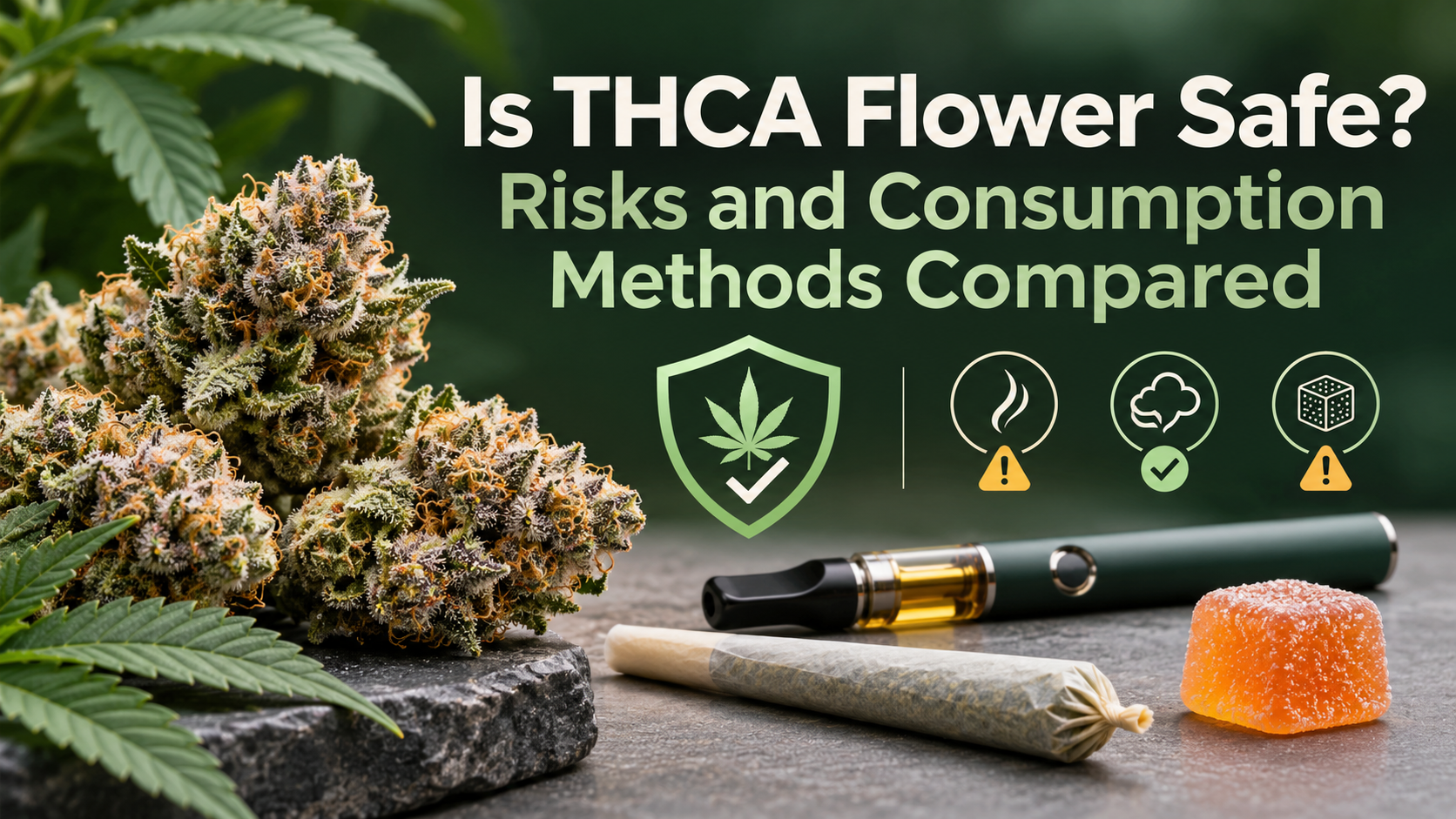
No way of using THCA flower is risk-free. THCA flower is a THC product, so it carries the health risks public health agencies attach to cannabis, and how you consume it changes which risks matter most. Smoking is the hardest on the lungs, vaporizers reduce some risks but are not risk-free, and edibles avoid inhalation but are easier to overdo. Product quality is a separate question, and only a lab report for your exact batch can answer it.
This guide compares the main consumption methods, lays out the documented health risks, and shows how to check a batch before you buy. It is general information, not medical advice.
Key Takeaways
- Smoking burnt cannabis is likely the most hazardous method.
- Vaporizers and e-cigarette devices reduce key risks but are not risk-free.
- Edibles avoid inhalation risks, but their effects start later and can lead people to take too much.
- The CDC lists impaired driving, cannabis use disorder, heart effects and lung harm among the risks of cannabis use, and says the risks exist however it is used.
- A recent, batch-matched COA with pesticide, heavy metal and microbial results is the best screen for product safety.
What Are the Health Risks of THCA Flower?
The CDC's cannabis health pages describe risks that apply to any THC-containing product (CDC, Cannabis Health Effects, Feb. 2024):
- Driving. Cannabis can slow reaction time and impair decision-making, coordination and perception. Mixing it with alcohol increases impairment.
- Cannabis use disorder. About 3 in 10 people who report using cannabis have cannabis use disorder, and the CDC says that figure is rising. Risk is higher for people who start young and use often.
- Heart and blood vessels. Cannabis can make the heart beat faster and raise blood pressure right after use, and it could increase the risk of stroke, heart disease and other vascular disease.
- Mental health. Use has been linked to social anxiety, depression and schizophrenia, though the CDC says these relationships are not fully understood.
- Lungs. Smoked cannabis can harm lung tissue and cause scarring and damage to small blood vessels, however it is smoked.
- Potency. Highly concentrated THC products are associated with more severe cannabis use disorder symptoms.
Daily or near-daily use is among the strongest predictors of severe or long-term harm. People with a personal or family history of psychosis or substance use disorders should not use cannabis at all, and pregnant people should not use it either.
Smoking, Vaping and Edibles: How the Risks Compare
| Method | Main added risk | What the sources say |
|---|---|---|
| Smoking (joint, pipe, bong) | Lung harm from smoke | Likely the most hazardous method, especially when mixed with tobacco. Smoked cannabis can damage lung tissue and small blood vessels. |
| Vaporizers and e-cigarette devices | Unknowns | Reduce key risks but are not risk-free, and rigorous health studies are limited. |
| Edibles | Delayed effects, overconsumption, accidental ingestion | Avoid inhalation risks, but effects start later and can lead to higher doses. Greater risk of poisoning than smoked cannabis, and packaging that looks like snacks appeals to children. |
| Extracts and concentrates | Very high THC | Contain very high THC levels, and higher potency is linked to more acute and long-term problems. |
Smoking Flower
Smoke is the main issue. Health Canada advises people who smoke to avoid deep inhalation and breath-holding, because both increase how much toxic material reaches the lungs. Mixing flower with tobacco makes smoking riskier still.
Vaporizing Flower
A dry-herb vaporizer or similar device heats flower instead of burning it, which reduces key risks. It also says these devices are not risk-free and that long-term outcome data are thin, so "vaping is safe" is not a claim the evidence supports.
Edibles
Edibles skip the lungs, and with clear labeling and warnings, they may be the safest option. The tradeoff is timing. Because effects arrive later, people can eat more before the first dose is felt. Edibles carry a greater risk of poisoning than smoked cannabis, and that children who consume THC products can become very sick. Keep products locked, childproof, and out of sight, and call poison control at 1-800-222-1222 if a child or pet gets into them.
Concentrates
Concentrates are not flower, but many shoppers compare them with flower. Health Canada says extracts and concentrates contain very high THC levels, and higher potency is linked to more acute and long-term problems. Products with a higher CBD-to-THC ratio generally carry less severe risks.
How to Lower Your Risk With Any Method
Health Canada's guidelines point to a few habits that reduce harm no matter how you consume:
- Use occasionally. The guidelines suggest limiting use to one day a week, weekends, or less.
- Choose lower-THC products or higher CBD-to-THC ratios when possible.
- Go slowly with edibles. Delayed effects are what lead to higher doses.
- Avoid deep inhalation and breath-holding if you smoke.
- Do not drive for at least 6 hours after use, and skip alcohol.
- Stay away from it entirely if you are pregnant or have a personal or family history of psychosis or substance use disorders.
Is the Flower Itself Clean? Contaminants and COAs
Method risk is only half the picture. Hemp flower is an agricultural product, and what the plant was exposed to while growing and curing shows up only on a third-party test.
Researchers comparing state cannabis testing rules found no common standard. Thirty-six states and Washington, D.C. listed 679 regulated contaminants between them, including 551 pesticides, and allowed limits for the same contaminant varied by up to four orders of magnitude (Leung et al., Environmental Health Perspectives, 2022, summarized by Arizona State University). Those figures describe state cannabis programs, not Texas hemp, but they show why "lab tested" means little unless you can see what was tested.
Texas sets a floor for retail consumable hemp. DSHS says retail products must be free of heavy metals, pesticides, harmful microorganisms and residual solvents, and sold in tamper-evident, child-resistant packaging (Texas DSHS, Consumable Hemp Products FAQ).
A certificate of analysis (COA) is the lab report for a specific batch. Each panel screens for a different hazard:
| COA panel | What it screens for | Why it matters |
|---|---|---|
| Pesticides | Chemical residues from growing | Required to be absent from Texas retail hemp (DSHS) |
| Heavy metals | Metals such as lead and arsenic | Required to be absent from Texas retail hemp (DSHS) |
| Microbials | Yeast, mold, bacteria | Required to be absent from Texas retail hemp (DSHS) |
| Residual solvents | Leftover extraction chemicals | Required to be absent from Texas retail hemp (DSHS) |
| Cannabinoids | THCA, delta-9 THC, total THC | Tells you potency, not cleanliness |
How to Read a COA
- Batch match. The batch or lot number must match the label on your jar or bag.
- Independent lab. The report should come from a third-party lab, not the seller. Ask which lab tested it and whether it is accredited.
- Recent date. Old reports may no longer describe the flower you are buying.
- Safety panels. Look for pesticide, heavy metal, residual solvent and microbial results. A potency-only COA is not a safety test.
- Potency. A higher percentage means a stronger product, not a cleaner one.
Red Flags When Buying
- No COA, or a COA you cannot match to the batch.
- Buds that look or smell off, such as a damp, musty or chemical odor. When in doubt, ask for the COA or skip the batch.
- A price far below the local market for "exotic" flower.
- Vague labels with no lot number, harvest date or lab name.
For more on judging quality, see our guide to the best exotic THCA flower.
Frequently Asked Questions
Is smoking THCA flower worse than vaping it?
Health Canada says smoking burnt cannabis is likely the most hazardous method and that vaporizers reduce key risks, but it also says vaporizers are not risk-free and that rigorous studies on them are limited.
Are edibles safer than smoking?
Edibles avoid inhalation risks, and Health Canada says that with clear labeling and warnings they may be the safest option. They carry their own risks: effects start later, which can lead to higher doses, and the CDC reports a greater risk of poisoning, especially for children.
Is a higher percentage better or safer?
No. Percentage measures potency, not cleanliness. Health Canada links higher THC potency to more acute and long-term problems, so a stronger batch is not a safer one.
How do I know if a COA is real?
Match the lot number to your label, check that a named lab issued it, and ask the shop whether you can see the lab's own copy of the report. If any of those are missing, ask the shop.
Can I get lab-tested THCA flower at The Plug in Houston?
The Plug says its hemp products are lab-tested, with a COA for each batch. Ask for the COA for the exact jar or bag you are buying, and ask what is currently in stock under Texas rules. Details are on the hemp flower page and at the Beechnut and Chimney Rock locations.
The Bottom Line
THCA flower is not a mild option. Pick the method with the risks you can best manage: avoid smoke if you can, go slowly with edibles, keep products away from children and pets, and never drive after use. Then buy only from a shop that shows you a recent, batch-matched COA with full safety panels. Adults 21 and older only. These statements have not been evaluated by the FDA, and these products are not intended to diagnose, treat, cure or prevent any disease.
Ready to shop?
Lab-tested hemp, delivered or in-store.

